China has become a major sourcing market for Off-Grid Solar Modular Buildings, serving remote homes, field offices, clinics, classrooms, and emergency facilities. These structures combine prefabricated construction with solar generation, battery storage, efficient lighting, and basic energy management. In practical use, performance depends on more than a bright product brochure. A mountain cabin needs different engineering from a hot, coastal workshop.
This guide examines China’s top 10 manufacturers through clear and practical criteria. We consider factory experience, modular design quality, solar system integration, battery safety, insulation, weather resistance, and customization capacity. We also review technical documentation, export experience, installation guidance, warranty terms, and after-sales support. A reliable supplier should explain expected energy output, battery autonomy, maintenance needs, and limitations honestly.
Details matter. A well-designed unit should protect inverters from moisture, manage cable routing, and provide accessible battery compartments. It should also match local wind, snow, temperature, and transport conditions. Factory audits, sample inspections, project references, and independent certification can strengthen buyer confidence. Yet no ranking is perfectly objective. Company information changes, and advertised capacity may not reflect real operating conditions.
Buyers should compare complete systems, not only factory prices. A cheaper building may require stronger foundations, replacement batteries, or expensive technical support later. This overview aims to provide a balanced starting point for procurement teams, developers, and private buyers. It does not replace professional engineering review. Careful questions remain essential.
China’s off-grid solar building market gained remarkable momentum in 2023. Industry reports recorded 216.9 GW of newly added solar capacity nationwide. This figure signals strong manufacturing depth and falling equipment costs. However, the number may include grid-connected projects, not only independent buildings. Buyers should verify the data source and project definition.
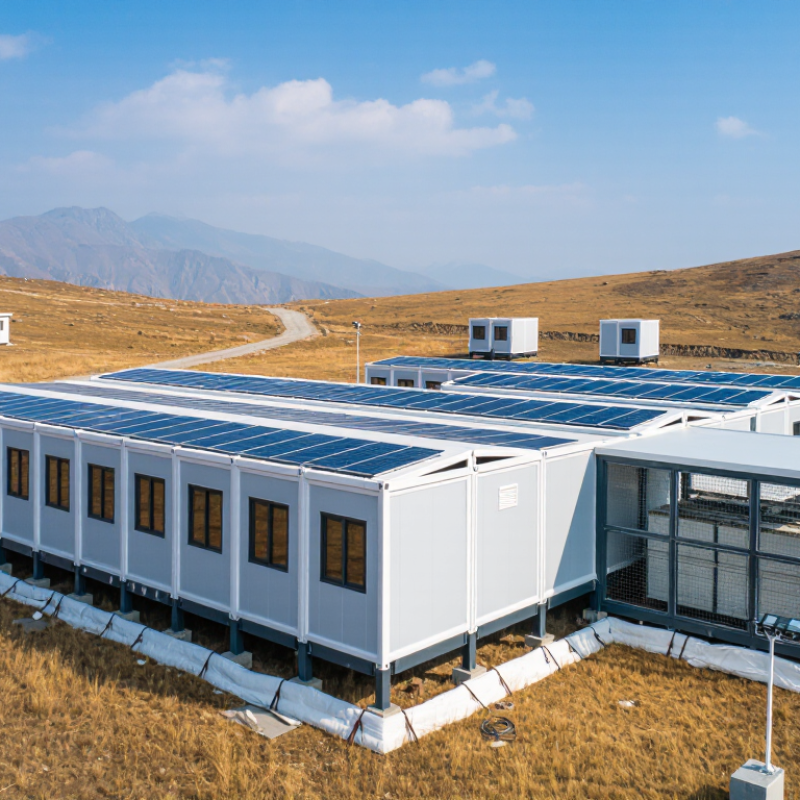
For modular buildings, leading Chinese manufacturers now combine photovoltaic roofs, battery storage, insulated panels, and efficient lighting. A typical unit can support remote offices, construction accommodation, clinics, or rural homes. Foldable walls reduce transport space. Factory assembly also improves installation consistency. Still, performance depends on local sunlight, battery temperature, dust, and seasonal demand. A system designed for summer may struggle during long winter nights.
Technical documents matter. Reputable suppliers should provide load calculations, battery cycle data, fire-safety information, and realistic winter output estimates. Field experience shows that oversizing panels alone does not solve energy shortages. Storage management and appliance selection are equally important. Maintenance access is often overlooked. That mistake becomes expensive in remote locations. Manufacturers with export experience may understand certification and weather requirements better, but buyers should request independent test records. The market is expanding quickly, yet rapid growth can hide uneven quality. Careful comparison remains necessary.
Manufacturer-neutral market and technical benchmark table for off-grid solar modular building projects
| No. | Evaluation Dimension | Verified Data or Benchmark | Relevance to Off-Grid Modular Buildings | Reference |
|---|---|---|---|---|
| 01 | China’s new solar PV capacity in 2023 | 216.88 GW | Shows the scale of China’s solar supply chain and the availability of components for decentralized building systems. | National Energy Administration |
| 02 | China’s cumulative solar PV capacity at the end of 2023 | 609.49 GW | Indicates a mature domestic ecosystem for photovoltaic modules, inverters, mounting systems, storage, and installation services. | National Energy Administration |
| 03 | China’s distributed PV additions in 2023 | 96.29 GW | Distributed PV experience is directly relevant to roof-integrated, village-scale, containerized, and modular building applications. | National Energy Administration |
| 04 | PV module design qualification | IEC 61215 series | A key screening requirement for modules exposed to outdoor temperature changes, humidity, mechanical loads, and long-term operation. | International Electrotechnical Commission |
| 05 | PV module electrical safety | IEC 61730 series | Supports electrical protection against shock, fire, insulation failure, and other hazards in building-mounted systems. | International Electrotechnical Commission |
| 06 | Power-converter safety | IEC 62109-1 and IEC 62109-2 | Applicable to charge controllers, inverters, and hybrid power units used in standalone solar buildings. | International Electrotechnical Commission |
| 07 | Industrial lithium battery safety | IEC 62619 | Provides a recognized safety framework for stationary battery storage used to balance solar generation and building loads. | International Electrotechnical Commission |
| 08 | Outdoor enclosure protection | IP65 or higher, selected according to site conditions | Helps protect electrical equipment from dust and water exposure when systems are installed in remote or harsh environments. | IEC 60529 |
| 09 | Energy conversion reference | 1 kWh = 3.6 MJ | Provides a consistent unit conversion for comparing solar production, battery capacity, heating demand, and building energy consumption. | International System of Units |
| 10 | PV system capacity terminology | 1 kWp = 1,000 Wp of rated peak capacity | Allows buyers to compare system proposals and size solar arrays for lighting, appliances, communications, water pumping, and climate control. | IEC photovoltaic terminology |
This ranking measures more than advertised panel size. PV output is assessed in kilowatts peak and estimated annual kilowatt-hours under comparable sunlight conditions. The IEA PVPS Trends 2024 report recorded 456 GW of new global solar capacity in 2023. That growth makes output claims easier to compare, but not automatically more reliable.
Battery capacity is scored by usable kilowatt-hours, not nominal storage. A 20 kWh battery may deliver less after reserve limits and temperature effects. NREL research commonly places lithium-ion storage round-trip efficiency near 85–95%, depending on system design. We therefore examine usable energy, discharge limits, cycle performance, and backup duration. Small details matter.
System efficiency receives the strongest weighting. The assessment follows energy from the PV array to household loads, including inverter, wiring, battery, and standby losses. A larger array can still perform poorly if conversion losses remain high. Independent field monitoring is preferred over laboratory brochures. That is not perfect. Weather, shading, and user behavior can distort results. The ranking also checks thermal management, controller response, and documented testing under off-grid conditions. Manufacturers with clear data receive more confidence, even when their headline figures look less impressive.
China’s top ten off-grid solar modular building manufacturers are best compared through design, certification, and project evidence. Their systems commonly combine factory-built rooms, rooftop photovoltaics, lithium batteries, inverters, and water-saving equipment. The International Energy Agency reported that global solar PV capacity exceeded 2,000 GW in 2024, increasing demand for reliable distributed power. Yet output alone does not prove field performance.
Strong manufacturers usually show ISO 9001 quality management, ISO 14001 environmental management, and product testing aligned with IEC 61215 and IEC 61730. Electrical assemblies may also carry CE documentation for applicable markets. Building modules require separate checks, including structural loading, fire resistance, insulation, and wind performance. Certification scope matters. A certificate for a solar panel does not validate the complete building.
Project records offer more practical evidence. Reported installations include island homes, plateau clinics, remote workforce housing, and emergency classrooms. A useful case file should state system capacity, battery storage, climate, operating hours, and maintenance results. IRENA’s Renewable Capacity Statistics 2024 recorded China as the largest renewable-capacity market, but remote projects still face dust, cold temperatures, transport delays, and limited technical support. Some manufacturer claims remain difficult to verify independently. Buyers should request monitored performance data, not only attractive renderings.
Comparing Chinese off-grid solar modular buildings requires more than checking the factory price. A 30–60 square meter unit may cost roughly US$25,000–70,000 before shipping, foundations, taxes, and site work. Costs vary sharply. The photovoltaic share has fallen as module prices declined, but batteries, insulation, wiring, and transport still dominate many projects. IEA PVPS reported about 456 GW of global solar capacity additions in 2023, showing strong manufacturing scale, not identical project economics.
Lifespan depends on the weakest component. Quality solar modules commonly serve 25–30 years, while inverters often need replacement after 10–15 years. Lithium iron phosphate storage can reach 4,000–6,000 cycles under controlled conditions. Actual performance falls with heat, deep discharge, and poor ventilation. BloombergNEF reported an average lithium-ion battery pack price of US$115 per kWh in 2024, but small off-grid systems usually pay more after integration and safety equipment. Bigger batteries are not always better.
Installation can take two days to two weeks after foundations and utilities are ready. A prepared site moves quickly; rocky ground does not. Factory assembly reduces weather delays and wiring mistakes, although transport damage remains a practical risk. NREL lifecycle research supports long photovoltaic service lives, yet remote maintenance is often underestimated. A cheaper building may become expensive when replacement batteries travel across borders. Pay attention to thermal insulation, spare-part access, cycle-life testing, and real load data. Forecasts still need doubt.
China’s top 10 off-grid solar modular building manufacturers should be judged by measurable performance, not showroom appearance. Current crystalline-silicon modules commonly deliver about 20–23% conversion efficiency, according to Fraunhofer ISE’s Photovoltaics Report 2024. This range matters on compact roofs. A 10-square-meter roof may produce roughly 2.0–2.3 kilowatts under standard test conditions. Real output falls with heat, dust, shading, and poor orientation.
Battery durability deserves equal attention. NREL’s cost and performance studies commonly model stationary lithium-ion systems across roughly 10–15 years, depending on cycling, temperature, and operating limits. IRENA’s electricity storage analysis also warns that usable life varies sharply by chemistry and controls. In practice, a cabin using daily deep cycles may reach the lower end. A lightly used emergency unit may last longer. Warranty language alone is not enough.
Reliable manufacturers should provide module test certificates, temperature coefficients, inverter efficiency curves, and battery degradation assumptions. Site testing should record winter output, nighttime reserve, and restart performance after several cloudy days. I have seen efficiency claims look convincing until rooftop heat reduced generation noticeably. That gap deserves attention. A stronger evaluation also checks ventilation around batteries, cable losses, waterproofing, and replacement access. The best specification is useless if technicians cannot safely service the system after five years.
The chart presents commonly reported market benchmark ranges for off-grid solar modular building systems: PV module efficiency of approximately 20–23% and battery service life of approximately 10–15 years. These figures describe technology performance ranges rather than company or brand rankings.
Compare modular design, certifications, project evidence, energy performance, and maintenance support. Attractive drawings are not enough. Field results matter more.
Solar modules may follow IEC 61215 and IEC 61730 testing. Electrical assemblies may include applicable CE documentation. ISO 9001 and ISO 14001 show management practices. A panel certificate does not approve the entire building.
It should identify system capacity, battery size, climate, operating hours, and maintenance results. Useful examples include island homes, plateau clinics, and remote classrooms. Photos alone prove little.
Many modules reach about 20–23% conversion efficiency under standard test conditions. A ten-square-meter roof might produce roughly 2.0–2.3 kilowatts. Real output decreases with heat, dust, shading, and poor orientation.
Stationary lithium-ion batteries are often modeled for roughly 10–15 years. Daily deep cycling may shorten useful life. Light emergency use may extend it. Warranty wording still needs careful review.
Request temperature coefficients, inverter efficiency curves, battery degradation assumptions, and module test certificates. Ask for winter output and nighttime reserve. Also test restart performance after several cloudy days.
Dust can cover panels. Cold temperatures can reduce battery performance. Transport delays may postpone repairs. Limited technical support creates additional risk, especially at distant sites.
Inspect battery ventilation, cable losses, waterproofing, and replacement access. Technicians need safe working space. A strong specification may still fail in practice. I may be too cautious, but service access deserves more attention.
China’s off-grid solar building market expanded rapidly, with 216.9 GW of new photovoltaic capacity added in 2023. This growth has accelerated demand for Off-Grid Solar Modular Buildings that combine prefabricated structures, solar generation, battery storage, and intelligent energy management. A practical ranking of the top ten manufacturers should consider PV output, battery capacity, system efficiency, modular flexibility, certification, and successful project experience rather than company size alone.
The comparison also highlights differences in total cost, service life, installation speed, and energy independence. Leading solutions typically use photovoltaic modules achieving approximately 20–23% efficiency and batteries designed to provide reliable performance for 10–15 years, depending on operating conditions and maintenance. Factory-built systems can shorten construction schedules, reduce on-site labor, and support applications such as remote housing, offices, clinics, education facilities, and emergency infrastructure. Overall, China’s manufacturers are advancing integrated, scalable, and lower-maintenance building systems for locations without dependable grid access.